

We spoke to Phil Little, a business development professional with 20 years’ experience in manufacturing and logistics, to kick off our three-part series on food waste in the UK.
Before waste, Phil worked in hospitality, recruiting for top chefs for restaurants, including Gordon Ramsay, Jamie Oliver, and Heston Blumenthal. Food has always been close to him—working with it, eating it, and understanding its journey—giving him a sharp perspective on how food waste impacts businesses, operations, and the environment.

“Food waste has changed massively over the past two decades,” Phil tells us. “When I first stepped into this industry, food wasn’t something we touched. Too complicated, too regulated, and too many people thought it wasn’t worth the effort. Back then, my work was all about general waste and recyclables — food barely registered on the agenda.”
Fast forward 20 years, and the picture is very different. Phil has walked factory floors where tonnes of perfectly edible produce are rejected simply because they don’t meet retailer specifications. He’s seen lorries leaving sites stacked with materials that represent huge financial, environmental, and reputational costs.
“Today, I work with some of the UK’s largest food and retail businesses to tackle these challenges head-on,” he says. “And if there’s one thing I’ve learned, it’s that despite the progress, we’re still getting food waste wrong.”
As new regulations come into force, Phil stresses that food waste is highly governed. DEFRA sets the policy framework, the Environment Agency enforces permits, WRAP publishes sector data and targets, the Food Standards Agency oversees safety, and retail audit schemes like BRC (Brand Reputation through Compliance) influence on-shelf specifications and supplier behaviour.
“Get those relationships wrong, and it’s not just food going to waste — you risk non-compliance, audit failures, and reputational damage,” he explains.
He adds that the Simpler Recycling initiative, which started on 31 March 2025, will standardise recycling across England with a common set of materials, weekly food waste collections, and separation of paper/card from other recyclables — making compliance and waste reduction simpler for both businesses and households.
This first instalment sets the scene for our series, exploring where the UK is now, what Phil sees happening on the ground, and how businesses are changing the way they view waste.
Food Waste Is Bigger Than Most People Realise
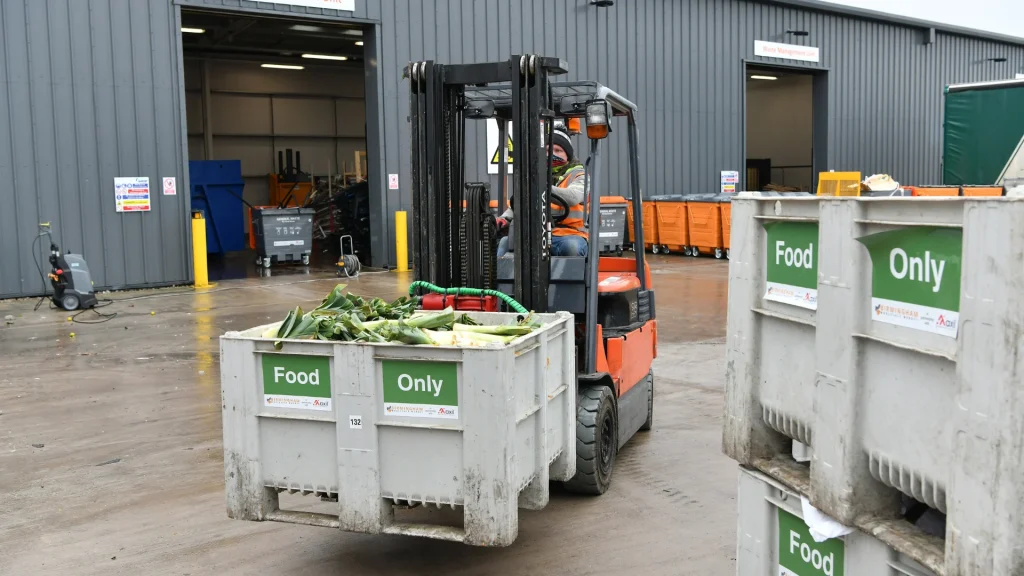
Food and drink manufacturing is a cornerstone of UK communities. With 11,675 businesses and 468,000 employees (some saying nearer 500,000), this sector is present in virtually every constituency, providing jobs, innovation, and economic impact. Its scale is a strength—but with it comes waste.
The figures speak for themselves. WRAP estimates UK hospitality and food service waste at over 1 million tonnes per year, with retail and manufacturing adding millions more. Globally, food waste generates 8–10% of greenhouse gas emissions—if it were a country, it would be the third-largest emitter after China and the US.
This isn’t a marginal issue. It’s a major operational, financial, and environmental challenge—and a huge opportunity for businesses to improve efficiency, reduce costs, and enhance sustainability.
Why Businesses Underestimate the Impact

The financials look small on paper.
According to Waste Watchers | Ellen MacArthur Foundation, it’s realistic to consider that waste can represent 4–5% of turnover.
Compared to energy or raw materials, waste might seem negligible — almost a rounding error. But in large food businesses, it quickly adds up: for a company with a £100 million turnover, that’s roughly £4–5 million a year lost, just on disposal, not including the value of the food, packaging, processing, and logistics wasted.
On the P&L, waste may look small compared to energy, labour, or raw materials, but it’s a highly controllable cost that often masks significant inefficiencies.

Retail specifications drive built-in waste.
Perfectly good fruit and vegetables are often rejected for not meeting strict size, shape, or freshness standards. This isn’t spoilage—it’s quality assurance. The key is that it’s a controllable cost: with the right approach, what might otherwise be wasted can be redistributed, recycled, or repurposed, delivering savings, social value, and environmental benefits. While some see it as inevitable, food businesses can treat it as a process to manage, not a cost to accept.

Disposal costs are deceptive.
Low per-tonne disposal costs mask the true financial impact of food waste. When upstream costs are included — growing, harvesting, processing, packaging, transporting — the value lost is significant. Even where rebates or efficiencies exist, poor practices can hide opportunities. Simple actions like staff education, clearer communication, and smarter operational decisions can unlock meaningful savings, making waste a controllable and valuable area for improvement.
The Myths That Need Challenging
There are a few things I hear time and again that hold businesses back:
- “We already recycle our food waste.”
Often, ‘recycling’ is just sending food waste to AD. Real impact comes from early interventions and circular solutions — waste prevention measures, redistributing surplus, finding new uses for what’s perceived as waste, and recycling plastics into new products. Axil helped one farm-to-fork provider divert 50 tonnes of laminated plastic every month, shifting from costly energy recovery to recycling — delivering a 43% monthly saving and stronger ESG results.
- “Segregation isn’t worth the effort.”
In reality, poor segregation drives costs up and contaminates recyclables. At Birmingham Wholesale Market, better segregation cut general waste by 222 tonnes, lifted recycling 92%, and reduced collections 66% — proof it pays back fast.
- “The impact is only environmental.”
Wrong. Food waste isn’t just a cost — it’s one of the heaviest financial and environmental commodities a site carries. Managed properly, it can save money and create value. For one food producer, Axil delivered a 39% reduction in CO₂ emissions while achieving cost-neutral waste operations.
Phil says: “Sure, we could send it a couple of miles down the road to an incinerator, but the real benefits—for the customer and for broader sustainability—come from creating value with that waste, not just moving it. That’s a real win-win in the food sector. Many waste organisations stick to the old model because alternatives don’t make them money, but this approach benefits everyone.”
He adds that too often it’s still the old linear take-make-throw model, but more food companies are now recognising waste as a controllable part of the business—a positive shift for both operations and sustainability.
Don’t Forget Water
One area often overlooked is water use in food manufacturing. Many sites run thousands of litres per hour through production and cleaning — untreated, this creates both a compliance headache and a hidden cost.

Technologies such as DAF (dissolved air flotation) plants and closed-loop wash systems provide an efficient, cost-effective way to treat process water, wastewater, and effluent. They remove suspended solids, enabling water to be recycled on-site, reducing effluent charges and operating costs. Currently, only around 30% of water is reused, showing the untapped potential for efficiency and sustainability. In most well-managed plants, treated water can be safely discharged—subject to water board consent—into local reservoirs, lagoons, or rivers. If it doesn’t meet standards, further treatment is required.
“In my view, water management will become as critical as food waste over the next decade — and the right technology and equipment are key to both compliance and efficiency.”
The Takeaway
Food waste isn’t just an operational by-product. It’s a test of how serious businesses are about sustainability, efficiency, and innovation.
Yes, the regulations are tightening. Yes, the reporting requirements are getting tougher. But more than that — there’s a real opportunity here. An opportunity to cut costs, improve ESG performance, support communities and make a tangible difference to environmental outcomes. Food waste isn’t straightforward — it’s highly governed, and mistakes carry financial, operational, and reputational risk. Businesses need support to navigate Environment Agency and DEFRA regulations, plus BRC and other audit requirements.
Phil adds:“In my role at Axil, I see this every day: when businesses stop treating food waste as an unavoidable cost and start treating it as a controllable resource, real change happens — for both operations and environmental performance.”