
The best waste management company for a business is not necessarily the one offering the cheapest collection.
For complex UK operations, waste management can involve multiple sites, suppliers, waste streams, hazardous materials, compliance requirements, recycling targets and rising disposal costs.
The right provider should be able to manage those moving parts together, while finding practical ways to reduce cost, improve recycling, strengthen compliance and recover more value from waste.
That is the difference between collecting waste and managing the waste operation.
What should you look for in a waste management company?
A good waste management company should be able to manage more than collections. It should combine waste management, recycling, supplier management, compliance, data, hazardous waste capability and continuous improvement into a service that works for the customer’s operation.
That is the approach Axil takes.
Total Waste Management brings these elements together under one accountable service, giving customers a single view of their waste operation rather than a collection of disconnected services and suppliers.
Start with what is happening on site
Waste management is an operational issue.
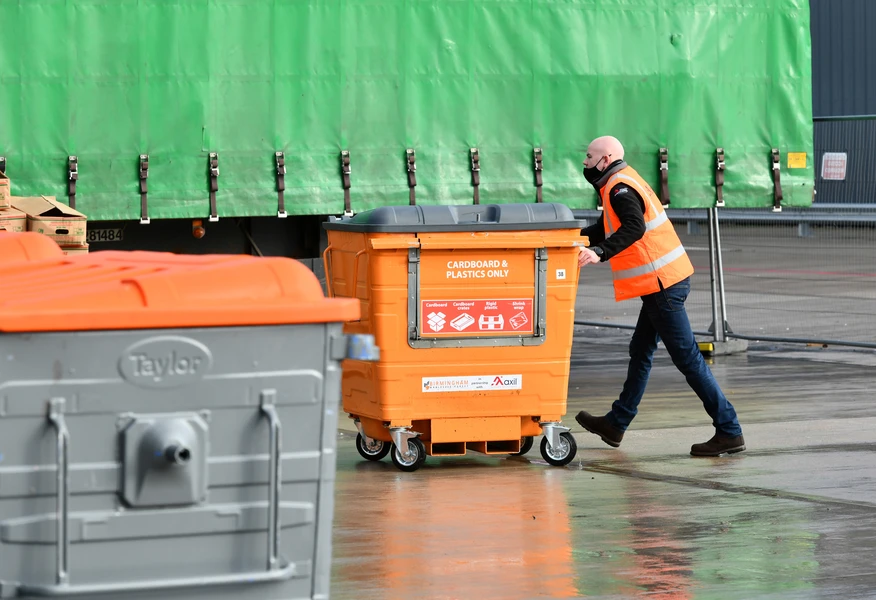
How waste is segregated, stored, moved and collected can directly affect cost, recycling and compliance. That is why Axil works alongside customer teams on site, rather than managing everything remotely.
More than 160 Axil people work directly within customer operations, helping identify practical improvements.
That might mean changing collection frequencies, improving segregation, changing container arrangements or finding a better route for a particular waste stream.
The principle is simple: understand the operation first, then improve it.
Make waste data useful
Once you understand what is happening on site, you need the data to see the bigger picture.
Axil’s Customer Portal gives customers visibility of waste volumes, costs, collections, compliance and destinations.
It currently supports more than 1,600 users and holds more than 74,000 documents.
That means customers can move beyond asking, “What did we spend?” and start asking better questions:
Why are costs increasing? Which sites are performing differently? Where is waste going? What could be recycled? And where is there an opportunity to improve?
Look at what happens to waste after collection
A waste management company should also be able to demonstrate control beyond the customer’s site.
Axil manages a network of more than 900 approved suppliers, using local and UK SMEs where appropriate, while maintaining direct capability where specialist control is important.
This includes hazardous waste.
Hazardous waste needs specialist capability
Hazardous waste requires more than arranging a collection.
Classification, packaging, documentation, transport and treatment all need to be managed correctly.
Axil has direct hazardous waste capability through its EA-permitted Cannock facility, supported by in-house chemists and two Dangerous Goods Safety Advisers.
That specialist capability sits within the wider waste management service, rather than requiring the customer to coordinate another provider.
Waste can be a cost, but it can also have value
The price of a collection is only part of the commercial picture.
Collection frequency, container utilisation, segregation, contamination, treatment routes and commodity values can all affect the cost of managing waste.
Axil looks at these factors together.
That can identify opportunities to reduce unnecessary collections, improve recycling, reduce disposal costs and recover more value from recyclable materials.
Commodities & Rebates helps customers identify and manage potential value from recyclable commodities alongside their wider waste operation.
What does good waste management look like across multiple sites?
For businesses operating across several locations, consistency and visibility become even more important.
Axil works across the UK and Ireland, supporting nearly 300 customers and complex operations across multiple sectors.
The objective is not to make every site identical. It is to understand what each operation needs while giving the customer a consistent approach to governance, data, compliance and improvement.
Look for evidence, not just a service list
The best way to compare waste management companies is to look at what they have changed for customers.
At Whirlpool/Beko Europe, Axil’s seven-year programme covers two locations and includes eight Axil operatives working on site. The programme has also generated more than £200,000 in rebates.
At Bespak, changes to waste handling reduced cardboard collections from around 50 bins a day to 25, while B8 collections reduced from five or six a day to two or three.
Different businesses. Different challenges. The same principle:
Understand what is happening. Find the opportunity. Make the operation work better.
So, what makes a waste management company the right choice?
For a complex operation, look for a company that can:
- Manage the whole waste operation, not just collections
- Work alongside teams on site
- Provide clear waste and cost data
- Manage suppliers and multiple sites
- Handle hazardous and specialist waste
- Improve recycling and recovery
- Identify opportunities to reduce cost
- Demonstrate measurable customer results
This is what separates a waste collection service from total waste management.
How Axil approaches waste management
Axil manages waste for complex operations across the UK and Ireland.
We combine people, specialist capability, technology and operational experience to select, manage, monitor and resolve across waste streams, suppliers, compliance, collections, recycling, recovery and continuous improvement.
The measure of success is straightforward:
Lower cost. Better control. More recycling. More value recovered.
Reviewing your waste operation?
If you want to understand where your waste operation could work better, Axil can help.