
Delivered through operational waste management, local supply chains, employment, support for community projects, and reuse-led material recovery in complex industrial environments.
Across 2024 and 2025, Axil generated £32 million of Social Value through operational delivery across customer sites, supply chains, upskilling of the workforce and material recovery systems.
This is not a standalone programme. It comes from how services are designed and delivered every day.
Most waste contracts are still only measured on cost, service levels, and compliance. That explains what is removed from site, not what value is created across the wider system.
That gap is where social value sits.


How it is measured
Axil uses the Social Value TOMS framework (Themes, Outcomes and Measures).
This is a recognised methodology used in public procurement that assigns financial value to defined social, economic, and environmental outcomes.
It allows real operational activity to be translated into measurable impact based on outcomes, not assumptions.
It ensures consistency across customers, contracts, and time.
But the framework is not the point.
The point is what it reveals: value is already being created inside operational systems, it just isn’t always measured.
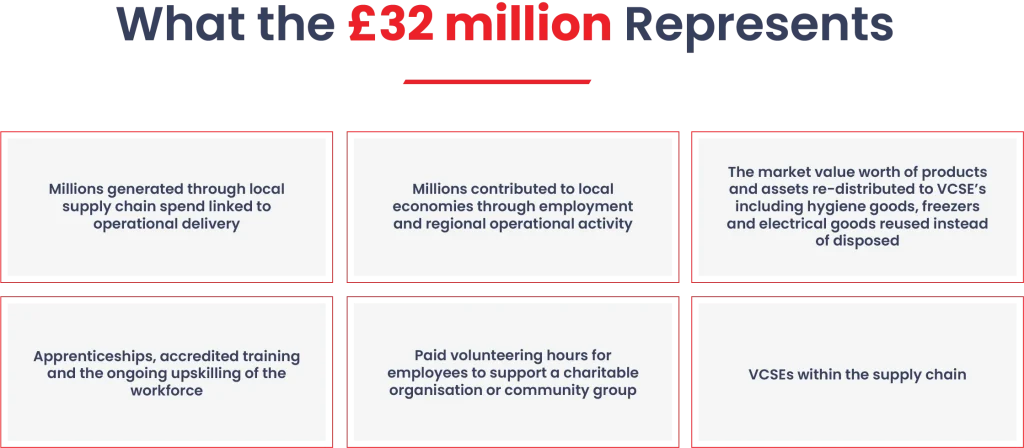
Examples of this activity include:
Reusable assets and FMCG surplus products totalling a market value worth tens of thousands redistributed between 2024-2025, with said surplus products and assets going on to aid in the support of more than 1,100 charities (supported by published case study on our website).
Ongoing apprenticeships, accredited training for the workforce to promote internal upskilling, growth and opportunities.
Paid volunteering hours to support VCSE’s, community projects, community groups and students at local educational institutions of an employees choosing.
Embedding VCSE suppliers within the supply chain to promote supplier diversity and social value, such as the employment of 15+ marginalised individuals.
These activities sit under Axil’s wider approach to waste avoidance and social value through reuse and redistribution, where material recovery is prioritised over disposal wherever possible.
Why this matters
Waste is still widely treated as a disposal function. But in reality, it behaves like a value system.
It influences procurement, supply chains, employment, and material recovery every day.
The issue is not whether value exists. It is whether it is recognised and elevated.
When it is measured properly, value is shown to already exist within the system.
The difference is whether it is captured or lost.
Axil’s position
At Axil, social value is not an add-on.
It is a direct output of how we design and deliver operations with undiluted attention given towards areas of opportunity to access and promote social value.
We focus on reducing cost, improving efficiency, and increasing value recovery from materials wherever possible.
Social value is what happens when those principles are applied consistently across complex industrial environments.
It is measurable because it is real, and scalable because it is embedded in operations

“Social value is now something we can properly evidence. It helps us recognise the impact our people are already making and turn it into measurable value we can stand behind.”
The question for the sector
If £32 million of value can be generated through operational waste delivery, the question is simple:
What value is currently being left unmeasured in your system?