

Building on Parts 1 and 2 In Parts 1 and 2, we explored the current state of food waste management and the innovations driving recovery and efficiency. Now, looking ahead, Phil Little, Senior Business Development Manager at Axil, offers his perspective on the future of food waste — and why collaboration, culture change, and proactive leadership will define success.

“If all the different elements of the process don’t collaborate, we’re never going to move forward. Teams often operate in isolation, unaware of the financial or environmental consequences of underutilised containers or inefficient segregation. Getting everyone aligned is the biggest challenge — and the biggest opportunity,” says Phil.
This article examines emerging trends, risks, and leadership approaches, drawing on Axil’s deep experience across multiple food manufacturers and processors. It shows how businesses can prepare for the decade ahead, reduce costs, cut CO₂ emissions, and unlock new value from their waste streams.
The Next 5–10 Years: Where Food Waste Management is Heading
“The food sector is under pressure like never before,” says Phil. “Retailers often dictate packaging, sustainability, even waste standards. If teams don’t collaborate upstream and downstream, processes fall apart — and opportunities for cost savings and carbon reduction are missed.”
Increasing legislative pressure, ESG expectations, and consumer demand mean businesses can’t just manage waste — they must optimise it. Mandatory food waste reporting and stricter recycling rules make alignment across procurement, production, operations, sustainability, and suppliers essential.
The biggest shift we anticipate? Integration. Cross-functional collaboration is key. Without it, processes fail, and financial and carbon-saving opportunities are lost.
Production-First Reality & External Pressures

On every factory floor we visit, the same truth repeats: production comes first. Any process that risks slowing lines, adding complexity, or introducing uncertainty simply won’t get done — no matter how noble the intention.
Several external pressures stack the odds against optimal waste outcomes:
• Council recycling rollouts: Councils are rolling out simpler household recycling schemes (full rollout due March 2026), pushing volumes into anaerobic digestion (AD) and straining processing capacity. Industrial waste streams are squeezed as municipal priorities take precedence.
• AD and processor capacity: AD and other processors prioritise guaranteed council volumes, not necessarily high-yield production waste, meaning manufacturers often face limited options or higher costs for segregated streams.
• Bin availability and lead times: Single-supplier approaches can collapse when the market is short, making it difficult to implement ideal segregation flows.
• Retailer packaging and planogram constraints: Retailers dictate packaging design, sustainability measures, and shelf positioning, limiting manufacturers’ freedom to redesign for recyclability. Faced with these pressures, teams understandably default to the simplest route: general waste or the nearest AD option. While easy, this approach is costly — both financially and environmentally — and leaves value on the table. Where the Value Actually Is Axil’s work isn’t about green window-dressing. It’s about finding measurable uplifts that make business sense. A few real outcomes we’ve delivered for our customers:
• Recovering value from wet feed through specialist processing — rather than standard AD — can significantly increase returns, potentially boosting value several-fold compared with traditional disposal routes.
• Fat processing: Segregated fat streams sent to appropriate processors can reach £1,000–£1,500/tonne, rather than being diluted through AD.
• Starch recovery: Separating starch boosts recyclability and creates secondary industrial streams back into manufacturing.
• Container optimisation: A network audit at one of our convenience food producers uncovered ~£22K/month in potential savings by right sizing and re-sequencing compactor usage across sites, equating to £264K annually and significant CO₂ reductions.
“Many customers still send wet animal feed or oils straight to AD,” Phil explains. “We’ve learned that sending these to a specialist recovery facility can transform value.”
Why Teams Don’t Do It — And How Axil Fixes It
People aren’t lazy. They’re busy, accountable for outputs, and rightly cautious about anything that might slow production.
Here’s what stops change — and how Axil removes each barrier:

Production comes first
Barrier: Any perceived risk to uptime kills new processes.
Axil fix: Segregation flows that don’t interrupt the line — same-footprint bins, inline caddies at changeovers, and pilots on low-risk shifts to prove zero downtime.

Time pressure / “I haven’t got time”
Barrier: Operators juggle quality, speed, and incidents; training feels like a luxury.
Axil fix: Micro-training (short session that don’t impact production), point-of-decision visuals, and floor champions who nudge behaviour without stopping the line. Complexity (HACCP, FEMAS, ABP rules) Barrier: Multiple regulations and offtake rules create paralysis; teams default to general waste. Axil fix: Simple, HACCP-aligned process maps, one-page SOPs, and audit-ready documentation — compliance becomes a route to market, not a blocker.

Space & layout limits
Barrier: No room for extra bins or bulkers.
Axil fix: Creative placement, shared caddies, short distance holding, and logistic routing that keep the footprint clear.

No visible local benefit
Barrier: Site teams rarely see the financial upside — savings go to central budgets.
Axil fix: Local dashboards showing £ saved and CO₂ avoided; tie small KPIs to site performance so teams see results.

Change fatigue
Barrier: Too many one-off initiatives have failed before.
Axil fix: Rapid, measurable pilots (2–4 weeks) with guaranteed offtakes — proof before scale.

Unreliable offtake markets
Barrier: AD full or expensive — segregated streams have nowhere profitable to go.
Axil fix: Multiple confirmed offtakes up front: AD where appropriate, rendering, specialist oil/starch recovery, and animal-feed buyers.

Procurement & retailer friction
Barrier: Packaging redesigns need retailer sign-off; supply-chain changes stall.
Axil fix: Focus on downstream fixes that don’t require retailer approval while running parallel engagement for long-term packaging change.

Audit & compliance fear
Barrier: Teams fear new procedures will fail HACCP audits.
Axil fix: Segregation embedded into HACCP plans, FEMAS, GB/AGB registration, and audit-ready evidence.

Agency staff / turnover
Barrier: Training never sticks with a rotating workforce.
Axil fix: Ultra-simple systems, induction cards for agency staff, and permanent site champions.
The System That Makes Pilots Permanent
Five linked elements ensure scalable, defensible change:
• Compliance route to market: HACCP, FEMAS, GB registration.
• Operational fit: Segregation designed to respect uptime.
• Multiple offtakes: Diversified processors protect against shocks.
• Data & audit trail: Track £, tonnes, CO₂.
• Supply-chain collaboration: Packaging and retailer engagement. Actionable Insights for Businesses
• Optimise bin utilisation to prevent lost efficiency and reduce CO₂.
• Segregate recoverable materials: fats, oils, starches.
• Embed compliance and culture: HACCP, FEMAS, GB.
• Collaborate across the supply chain for operational excellence.
• Leverage data to track, report, and act.
Axil’s Leadership in the Future of Food Waste
At Axil, we translate insight into action. Our approach combines operational expertise, regulatory knowledge, and sustainability leadership to help clients unlock value across waste streams.
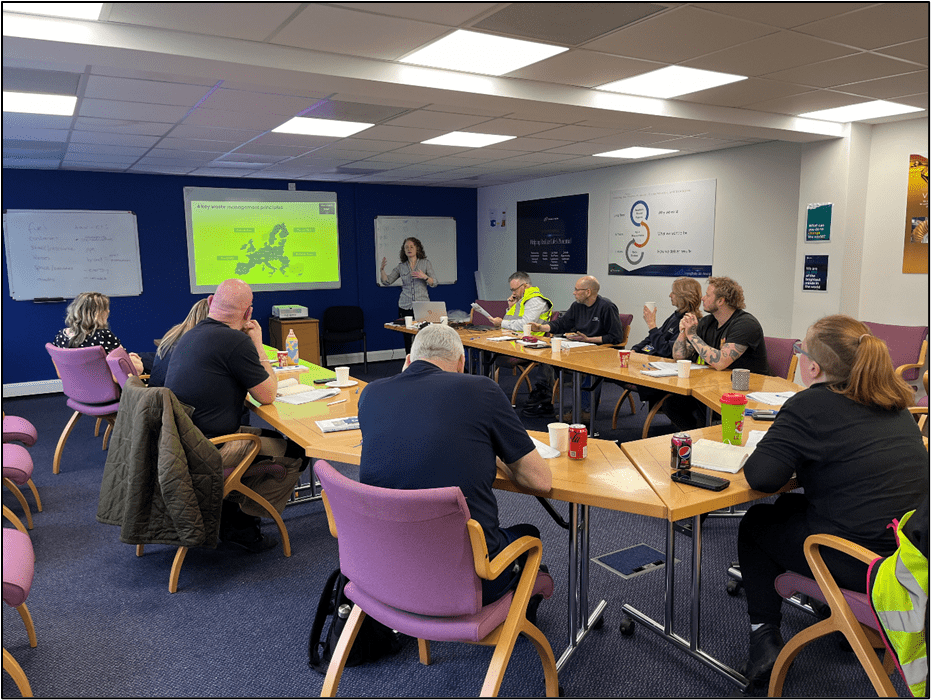
• Education & awareness: Site audits and staff training embed a culture of optimisation.
• Collaboration & partnership: Alignment across suppliers, operators, and clients maximises recycling, recovery, and CO₂ savings.
• Innovation & value recovery: Overlooked streams such as oils and starches deliver both environmental and commercial uplift.
Preparing for Tomorrow
“The future of food waste isn’t just about compliance — it’s about leadership,” Phil says. “Businesses that invest in education, collaboration, and data-led optimisation will reduce costs, cut CO₂ emissions, and unlock new revenue streams.”
Axil’s experience shows that by taking a proactive, integrated approach, the food sector can transform waste from a cost into an asset — today and for the decade ahead.