
How Axil ‘s innovative approach has made it the fastest growing waste management company in the UK.

Axil is an innovative UK-based waste management company. Chief Executive, Ed Pigg, describes how the business began: “I joined a small PLC back in 2012, forming a division within that business. Then, in 2018, we executed a management buyout; that’s when the Axil brand came into being.
A Name with Purpose
Axil is a botanical term; it is the point at which a leaf leaves the stem. I wanted something that represented our dedication to sustainability but less overtly because lots of waste companies have green in their titles and branding. It had to be something a bit more oblique and quite corporate because we don’t want to be a high street name. We have a very tight strategy around dealing with large manufacturers, and in the main, they are large corporate entities. We wanted a business that had the same look and feel as our customers, which is why we have a very corporate approach to everything that we do.
“What we do for our customers is help them reduce their costs for waste management and improve their environmental performance. That’s our strategy in a nutshell. We define ourselves as a total waste management company — but for us, waste isn’t just rubbish. Waste is anything that drains resource, time, or effort away from a customer’s core business. That could be materials, manpower, water, equipment — anything not adding value to their operation. Our role is to manage all of that — and to turn it into something valuable.”
Turning Waste into Value
“Rather than it being consigned to a bin that goes to general waste, to landfill or to incineration, we work with our customers to segregate materials and put them in a form that can be turned into a commodity. There was a statistic years ago that stated: for every ton of waste that goes into the ground, there is around £50 worth of value. That value could be from cardboard, plastics of all different grades, and of course, metals—all the different types from ferrous to non-ferrous. That’s what we’re doing for our customers; we are helping them recover all that value before it goes to incineration or landfill.
“We think about waste as a resource. Traditionally, a waste company wants you to fill up the bins at the back of your operation, and then the waste operator will come and take those away. But what we are trying to do is work with our customers and help segregate materials more effectively, so rather than having a single skip at the back of a customer’s site, they might have ten different containers containing materials that are going to be diverted for reuse or recovery. Instead of a traditional waste business collecting the combined refuse, we are quite scientific; for example, we make sure to engage with customers during the production cycle rather than just dealing with the waste at the end of that cycle.”
People First: The Foundation of Axil’s Success
Ed then reflects on what has contributed to the company being recognised as one of Britain’s Best Places to Work by The Sunday Times:
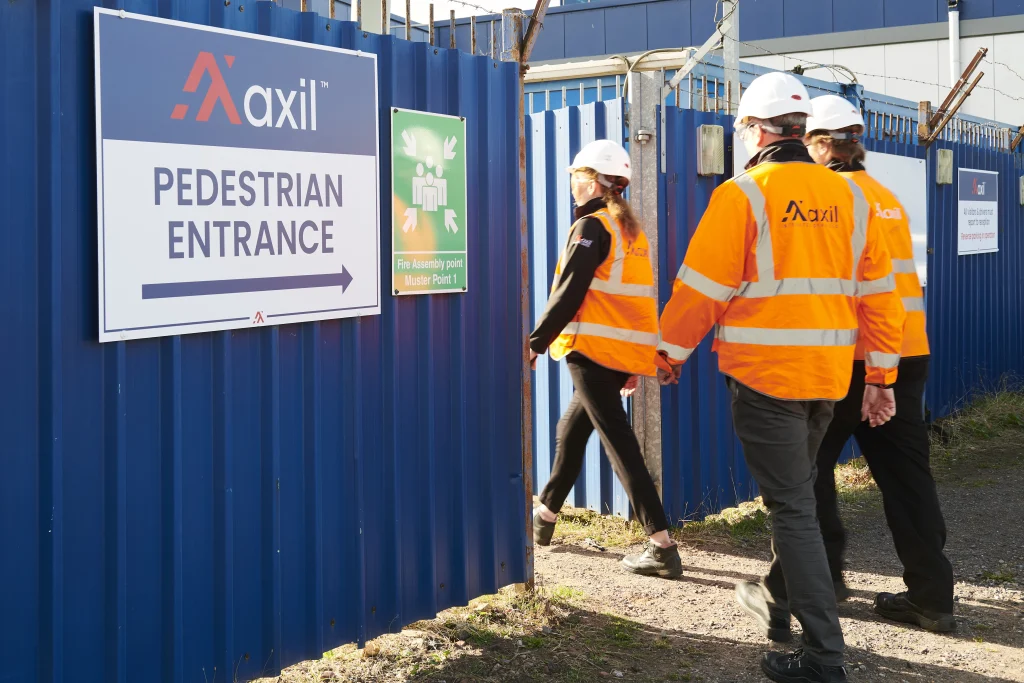
“We are a blue-collar business that relies on our people. Over winter, and on mornings like today, when it is freezing, I have people working outside in all weather, segregating materials and working with waste. It is a hard job. What we do at the executive level within Axil is recognise that our job is to serve our frontline operatives. We try to give them the best personal protective equipment. I would rather spend a little bit more on a protective jacket that is warmer and better quality than the cheapest option. Rather than providing a table to sit at outside, most of our sites have a mess facility, which includes areas to hang personal clothing and somewhere warm to have lunch or breaks because they do a difficult job.
“If you don’t look after your people, they will not look after your customers. If you don’t look after your customers, the renewal rate drops, the churn cycle goes up, and that costs shareholders. We have created this virtuous circle: shareholders want me to look after my staff because my staff look after my customers, and my customers value what we do, pay our bills, and don’t go anywhere else.
“In 2018, we only had 34 staff; today, we have 250, and by the end of the year, this will reach 300. What is great about that is that most of our supervisors and management came from within. One benefit of promoting from within is that our people understand our culture better than anyone else.”
This dedication to customer care is also reflected in the company’s impressive organic growth. Ed elaborates: “We are the fastest-growing waste management company in the UK (as recognised in the FT 1000) — and one of the fastest-growing in Europe. What makes that even more remarkable is that it’s all been driven by organic growth. We’ve got bold, ambitious plans to keep that momentum going.
Looking Ahead: Expansion and New Opportunities
Looking to the future, Ed identifies the significant and exciting opportunities that lie ahead: “I suspect we will be looking at opportunities outside of the UK, in Europe or other jurisdictions. There is also a level of knowledge now in Axil that really enables us to explore the consultative and advisory space, which is not something we have done before.”